Toilet, Faucet and Fixture Repair in Grand Rapids
Most fixture calls start small: a toilet that runs, a faucet that drips, a garbage disposal that hums and will not turn. We repair and replace toilets, faucets, showerheads, tub and shower valves and disposals, and we install new fixtures for kitchen and bathroom updates.
Fixture Problems You Can Fix and Ones That Need a Plumber
Many fixture problems come down to a worn rubber part that a handy owner can change with the water off. Others start inside the wall or at a valve that will not turn.
| Fixture | Common problem | Often a DIY fix? | When to call a plumber |
|---|---|---|---|
| Toilet | Runs between flushes or keeps filling | Yes, often | Water at the base, a cracked tank or a toilet that rocks |
| Kitchen faucet | Drips, leaks at the base or the sprayer weakens | Sometimes | A leak inside the cabinet or a handle corroded in place |
| Bathroom faucet | Slow drip, stiff handle or weak stream | Often | The drip returns after a new cartridge |
| Showerhead | Weak or uneven spray from mineral buildup | Yes | Water leaks where the arm meets the wall |
| Tub or shower valve | Spout drips, water swings hot and cold or the handle turns hard | Rarely | Most repairs: the valve sits behind the wall |
| Garbage disposal | Hums but will not turn, leaks or trips its reset button | Sometimes | A leak from the unit’s body or a motor that keeps tripping |
| Shutoff valve under a sink | Will not turn, or drips at the stem once moved | No | Before any faucet or toilet work if the valve is stuck |
Stop a Running Toilet
A toilet that runs on its own is losing water past the flapper at the bottom of the tank or through the fill valve on the side.
- Take the lid off the tank and set it somewhere soft; it cracks easily.
- If water spills into the overflow tube, the fill valve is set too high. Lower the float with its adjustment screw or clip, then flush and check the level.
- If the level is below the overflow and the tank still refills on its own, the flapper leaks. Food coloring in the tank that shows up in the bowl confirms it.
- Turn off the valve behind the toilet, flush to empty the tank and unhook the old flapper.
- Fit a flapper of the same size and leave a little slack in the chain when it is closed.
- Turn the water back on and listen as the tank fills. If it still runs, the fill valve needs replacing.
Faucets, Showerheads and Tub Valves
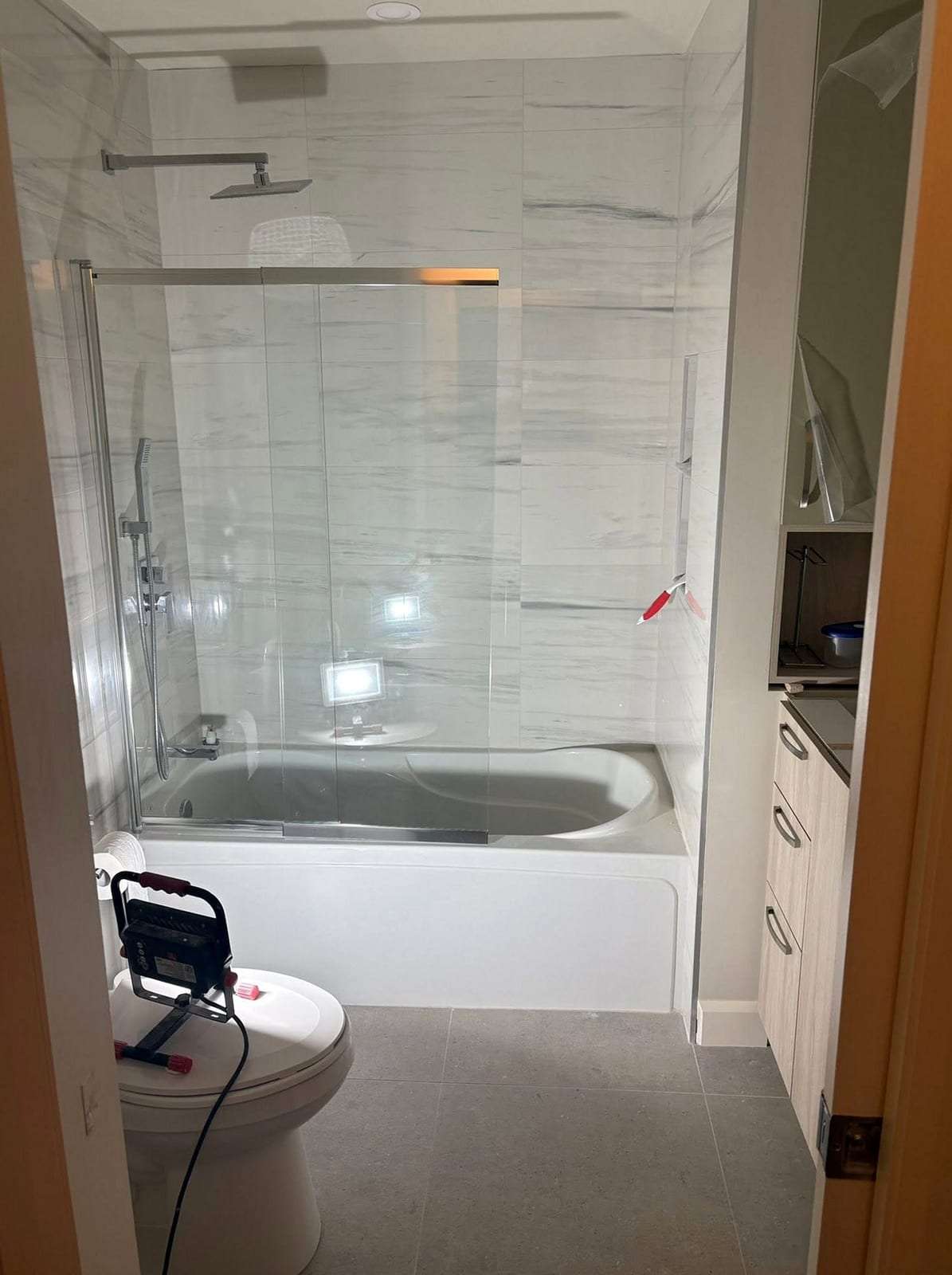
A dripping faucet is almost always a worn cartridge, washer or seal. On a newer faucet the part is easy to match; on an older one it may no longer be made, and a new faucet is the better repair.
Tub and shower valves sit behind the wall. A worn cartridge shows as a drip from the spout, a stiff handle or water that turns hot when a toilet flushes. Most cartridges come out through the trim, but an old valve may need replacing in the wall.
In older Grand Rapids houses with galvanized supply pipe, rust flakes clog aerators, showerheads and cartridges. When the flow stays weak at several taps, the trouble is the pipe itself, and that is a pipe repair rather than a fixture repair.
Garbage Disposal Swaps and New Fixture Installs
A disposal that hums but will not turn is usually jammed. With the power off, it can often be turned back by hand using the hex key in the socket underneath. One that leaks from its body or keeps tripping the reset button is worn out, and a swap is the practical repair.
New fixture installs run from a single faucet to a full bathroom of toilet, sink faucet, tub trim and showerhead. Zak Mitchell expects every joint under a sink to be wiped dry and checked a second time before we leave. A slow drip at a nut can take days to show as a stain on the cabinet floor.
Before Replacing a Fixture
- The shutoff valve under the sink or behind the toilet turns and stops the water fully.
- The fixture size and mounting type are noted: the distance from the wall to the toilet’s floor bolts, or how many holes the sink has for a faucet.
- Model details are gathered, such as a photo of the label on the disposal or the stamp inside the toilet tank.
- The floor around the toilet is solid, with no soft spots or stains at the base.
- For a disposal, you know whether it plugs into an outlet under the sink or is wired in.
- The cabinet under the sink is cleared so the valves and drain are easy to reach.
Questions About Toilets, Faucets and Disposals
Should I repair an old faucet or replace it?
If the faucet body is sound and parts are still made for it, a new cartridge or set of washers is the simpler repair. Replacement makes more sense when the base leaks, the finish is corroded, parts are hard to find or the faucet has already been repaired more than once.
Why does my toilet run for a few seconds every so often?
Water is leaking slowly from the tank into the bowl, usually past a worn flapper, and the fill valve tops the tank back up. A new flapper fixes most of these; if the seat under it is pitted, the flush valve needs replacing.
What should not go into a garbage disposal?
Grease, stringy scraps such as celery and corn husks, potato peels, coffee grounds, bones and fruit pits. They either jam the grinder or pass through and settle in the drain line. Run cold water before, during and for a few seconds after grinding.
Can I replace a toilet myself?
Many owners do. The key steps are draining the old toilet, setting the new one on a fresh wax ring without rocking it and tightening the bolts evenly so the base does not crack. Call a plumber if the floor around the flange is soft, the flange is broken or the shutoff valve will not close.
Having a Fixture Fixed or Replaced
If a toilet will not stop running, a faucet keeps dripping after a new cartridge or a disposal needs to be swapped, schedule a fixture repair or call (616) 681-4424. When you book, mention the fixture and any model details you have.